Fred Leplat compares and contrasts the plays “England Very Nice People” and “Pitmen Painters”
Two plays are currently on at the National Theatre which could not be more different from each other. “England Very Nice People” is by Richard Bean and directed by Nicholas Hytner, the NT’s director. At the interval, I was very uncomfortable, and by the end of the play was appalled. Bean describes it as a “comedy with songs” about immigration into Tower Hamlets. Bean’s view of Tower Hamlets is that as an immigrant from Yorkshire (sic) he found the borough “abrasive, violent, racist and tribal”. In a talk before the play, he also describes himself as a “liberal hawk” like David Aaronovitch.
The play starts with the Romans, then the Huguenots, the Irish, the Jews. The second half of the play is entirely about the Bengladeshis. The play tries to lampoon the stereotypes of immigrants, but Bean is unable to go beyond the stereotypes such as the snotty French Huguenots, the drunken incestuous Irish who live with pigs, the Jewish anarchists and the fundamentalist Muslim Bengladeshi.
Through the centuries, Bean describes each new wave of immigrants arriving with their own culture and prejudices, all fitting the stereotypes that the “native” English have of them at the time. But up until the young Bengladeshis arrive on the stage, immigrants settle and integrate through mixed relationships. Bean avoids as to whether integration can take place without necessarily through mixed relationships. How can a cosmopolitan city like London survive if it were not that there is both a degree of mixed relationships as well as people who have recently arrived establishing networks to maintain their cultural references, whether they come from Bengladesh or Wales. But more importantly, the integration happens through the shared struggle at work where a joint working class experience is developed.
Bean does not look at how new immigrants impact on the country they arrive in except through the use of stereotypes, such as Bengladeshis opening restaurants serving chicken tikka masala. Any attempt to redress the negative stereotype such as the drunken Irish is done through another stereotype such as the middle-class liberal free-thinker.
The second part was the most disturbing as it depicts the fundamentalist Muslim youths after 9/11. There is a particular unpleasant scene where these youth sit around an imam with no hands but hooks like Abu Hamza from the Finsbury Park mosque and who is accused of terrorism.
There is no attempt to examine the background to this development such as racism, poverty or class. There is no examination of the disillusion with the main parliamentary parties resulting in the lowest level of participation in elections. Instead, at the end of the play, we are left with the impression that it is the fault of the immigrants who refuse to integrate.
All this makes for a bad play both in terms of its literary content, as it is simply an addition of stereotypes and caricatures that do not develop throughout the play let alone the centuries, but it is also a play at which racists would probably feel comfortable as they could laugh at the sort of cruel jokes. It was that bad! At least there was a protest outside before the play by community activists from Tower Hamlets calling for a “right to reply” as they did not recognise the borough in the play.
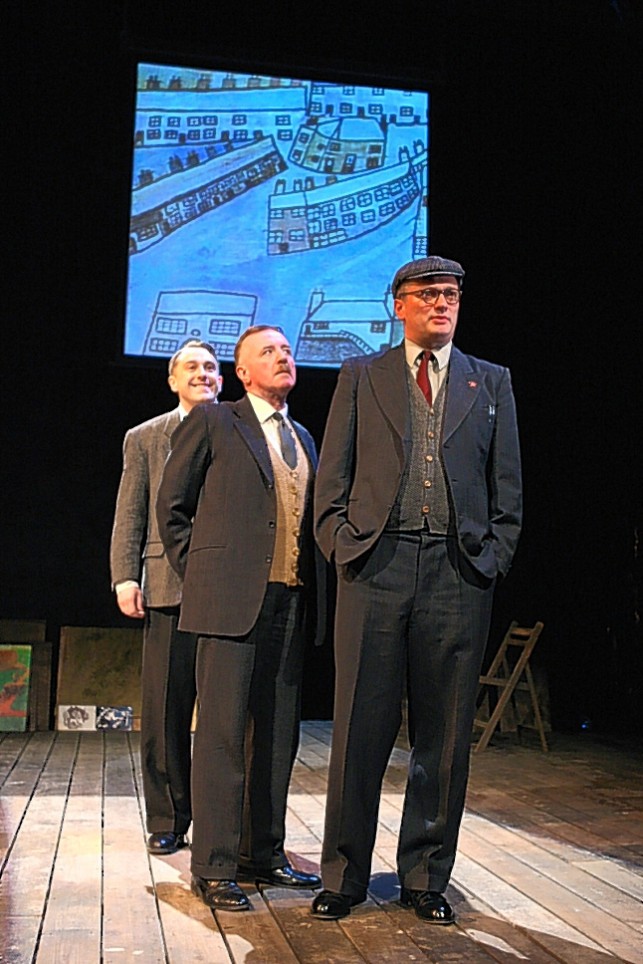
The contrast with the “Pitmen Painters” another play on at the National Theatre could not be greater. The play as its title suggests, is about a group of miners in Ashington, Northumberland, who become painters after attending in 1936 a WEA class on art appreciation. It is the “true story” of these workers who were told to paint when the lecturer realised that looking at slides of Titian paintings would lead nowhere.
The play is written by Lee Hall, who also wrote Billy Elliott, and like that film, it comes across as having been created by someone who has a sympathetic appreciation and understanding of the subject and of the times.
Unlike “England People Very Nice”, the characters in the “Pitmen Painters” are not stereotypes. You will however find traits in each character which develop and change over time. There is the rather formal and bureaucratic secretary of the WEA class and the communist sympathiser who is into social realism. The play centres on Oliver Kilbourn, the most talented of the group, who would have liked to become a full time painter, but knew that it would mean leaving his working class community, the source of his inspiration and energy, and instead become dependent on the rarefied world of art patronage. So Oliver stays in Ashington, but nevertheless manages to combine his work in the pit and create art which becomes known and appreciated.
The play is more than a story following the lives of a group of men working and painting. It deals with big questions such as working class access to art and education, the meaning of art and the “ownership” of art. These discussions are dealt with in a gripping manner as the “Ashington Group” has to deal with the practicalities for their new passion such as finding the time after backbreaking work and money to purchase materials in the recession of the late 1930s. They also have to manage their newly found fame without being compromised or corrupted by patrons and dealers.
The play is gripping not just because of the story and how it has been told, but also because the actors really understand and bring to life their characters. It is a deeply political play which the audience laps up with joy, from the opening scene when, to rapturous applause, the communist pays for the unemployed worker’s fee for the class and says that “he should not be made pay for the cyclical crisis of capitalism” right through to the closing moment with a savage stab at New Labour.
The Pitmen Painters is on until the 14 April at the National Theatre www.nationaltheatre.org.uk